 Cadentia
How to Describe a Photo in Spanish (and French) for Your IB Oral
A five-step structure for describing a photo in Spanish or French in the IB oral, the phrases for each step, and a worked example in each language.
Every IB Language B oral at Standard Level, and every ab initio oral, starts with a photo. You have a few minutes of preparation and then you talk about it. Most students know the words for what they see. What they lack is a shape: an order to say things in, the phrases that move them along, and a way to get from "there are people" to something worth listening to.
This guide gives you that shape in five steps, the Spanish and French phrases for each, and a worked example in each language. It is not official IB material, and your teacher's instructions come first.
The five steps
- Overview. One or two sentences: what kind of photo it is and where it seems to be.
- Details. Who and what you see, using place phrases: in the foreground, in the background, on the left.
- What is happening. Actions, and your best guess at what is going on.
- What it means. The theme, and a link to a Spanish- or French-speaking culture.
- Beyond the frame. What happened before, what happens next, who is not in the photo, what you would do.
Steps 1 to 3 are description. Steps 4 and 5 are where the oral really gets going. A common mistake is to spend three minutes on steps 1 to 3. In the Language B presentation, get through description in under a minute and move on.
The phrases, step by step
1. Overview
| Spanish | French |
|---|---|
| Esta foto muestra... | Cette photo montre... |
| Es una foto tomada en... | C'est une photo prise à / dans... |
| Parece que estamos en... | On dirait que nous sommes dans... |
| Se trata de... | Il s'agit de... |
2. Details: where things are
| English | Spanish | French |
|---|---|---|
| in the foreground | en primer plano | au premier plan |
| in the background | al fondo | à l'arrière-plan |
| in the middle | en el centro | au centre |
| on the left / right | a la izquierda / derecha | à gauche / à droite |
| at the top / bottom | en la parte de arriba / de abajo | en haut / en bas |
| next to | al lado de | à côté de |
| behind | detrás de | derrière |
And to say what is there: hay / il y a, se ve / on voit, aparece / on aperçoit.
3. What is happening, and guessing
| Spanish | French |
|---|---|
| Están + gerundio (están esperando) | Ils sont en train de + infinitif (ils sont en train d'attendre) |
| Parece que... | Il semble que... (+ subjonctif) / On dirait que... |
| Puede que + subjuntivo | Il est possible que + subjonctif |
| Me imagino que... | J'imagine que... |
| Seguramente / probablemente... | Sans doute / probablement... |
| Da la impresión de que... | On a l'impression que... |
The guessing phrases matter. You cannot know what is really going on in a photo, so parece que and on dirait que are the honest thing to say, and puede que and il est possible que bring in a subjunctive naturally.
4. What it means
| Spanish | French |
|---|---|
| Esta foto está relacionada con el tema de... | Cette photo est liée au thème de... |
| Me hace pensar en... | Elle me fait penser à... |
| En muchos países hispanohablantes... | Dans beaucoup de pays francophones... |
| En España / en México / en Argentina, por ejemplo,... | En France / au Québec / au Sénégal, par exemple,... |
| Lo que me llama la atención es... | Ce qui me frappe, c'est... |
The cultural link has to be specific. En los países hispanohablantes la gente vota says nothing. En Argentina el voto es obligatorio says something.
5. Beyond the frame
| Spanish | French |
|---|---|
| Antes de que tomaran la foto, ... | Avant que la photo soit prise, ... |
| Lo que no vemos es... | Ce qu'on ne voit pas, c'est... |
| Después, seguramente... | Ensuite, ils vont sans doute... |
| Si yo estuviera allí, ... | Si j'étais là, ... |
This is where the past, the future, the subjunctive and the conditional come from without forcing them.
A worked example in Spanish
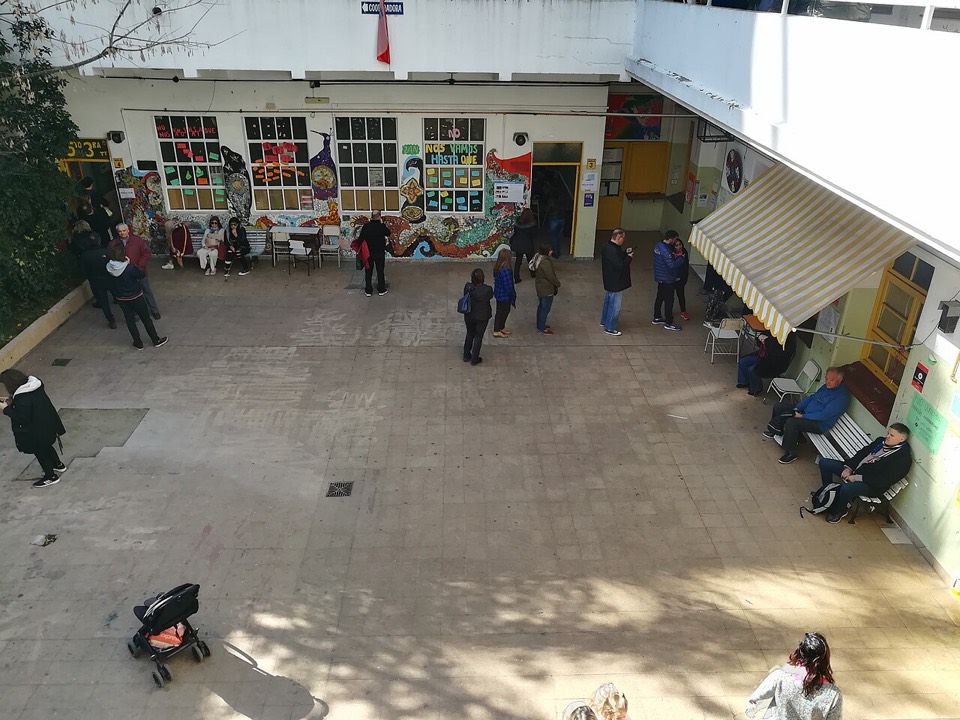
Photo: BugWarp / Wikimedia Commons, CC BY 3.0 (licence, source)

Theme: social organization.
1. Overview. Esta foto muestra el patio de un colegio. Parece que estamos en Argentina, y por lo que se ve, el colegio se usa como centro de votación.
2. Details. En primer plano hay un patio grande con baldosas y un cochecito de bebé. Al fondo se ven las ventanas de las aulas, con dibujos y murales de colores. A la derecha hay varias personas sentadas en un banco, debajo de un toldo.
3. What is happening. Algunas personas están esperando su turno y otras están hablando. Da la impresión de que es un día tranquilo. Puede que algunos hayan venido con toda la familia, porque se ve el cochecito.
4. What it means. Esta foto está relacionada con el tema de la organización social, porque muestra cómo funciona la democracia. Lo que me llama la atención es que se vota en un colegio, un lugar de todos. En Argentina, además, el voto es obligatorio para la mayoría de los adultos, así que estos lugares se llenan de gente el día de las elecciones.
5. Beyond the frame. Lo que no vemos es lo que pasa dentro de las aulas: las urnas, las listas, las personas que cuentan los votos. Si yo pudiera votar en mi país, creo que lo haría siempre, aunque no fuera obligatorio.
The description (steps 1 to 3) takes about forty seconds. Steps 4 and 5 bring in a perfect subjunctive (hayan venido), a cultural fact, and a si clause with the imperfect subjunctive (si pudiera... lo haría).
A worked example in French
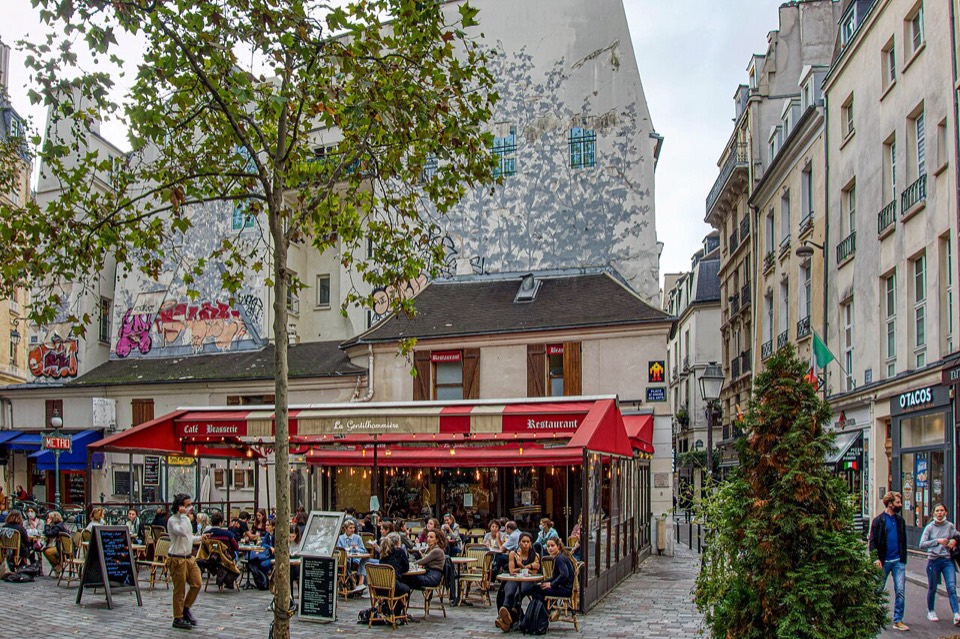
Photo: besopha / Wikimedia Commons, CC BY 2.0 (licence, source)

Theme: experiences (with a link to social organization).
1. Overview. Cette photo montre la terrasse d'un café dans une rue ancienne. On dirait que nous sommes à Paris, peut-être en automne.
2. Details. Au premier plan, on voit un arbre et des pavés. Au centre, il y a un café-restaurant avec des stores rouges et beaucoup de petites tables. À droite, deux personnes marchent dans la rue, et à l'arrière-plan on aperçoit de grands immeubles avec des balcons.
3. What is happening. Les clients sont en train de boire un café ou de discuter. Il semble qu'il fasse un peu frais, parce que certains portent des vestes. Un serveur est debout à côté d'un tableau noir, sans doute avec le menu du jour.
4. What it means. Cette photo est liée au thème des expériences, parce que la terrasse de café fait partie de la vie quotidienne en France. Ce qui me frappe, c'est que les gens prennent leur temps. En France, on peut rester longtemps à une terrasse avec un seul café, et personne ne vous demande de partir.
5. Beyond the frame. Ce qu'on ne voit pas, c'est le travail des serveurs, qui commence tôt le matin. Ce soir, la terrasse sera sans doute pleine. Si j'habitais à Paris, je crois que j'y viendrais pour réviser avec mes amis.
Again, description is short. The rest brings in a subjunctive after il semble que (fasse), a future (sera), and a si clause with the conditional (si j'habitais... j'y viendrais).
Five mistakes that cost time
- Listing everything you see. Hay un árbol, hay una mesa, hay una persona... Choose three or four details that matter for the theme.
- Describing colours and clothes at length. Useful at ab initio, a waste of time at Language B. One detail is enough.
- Stating guesses as facts. Están votando por el presidente when you cannot know. Say parece que or on dirait que.
- A vague cultural link. "In Spanish-speaking countries people like festivals" is not a link. A country, a custom, a fact.
- No ending. Plan your last sentence. Por eso, esta foto me parece... or C'est pour ça que cette photo... is better than trailing off.
How to practise this
Take any photo: a news photo, a page from a travel magazine, or one of our IB oral practice photos. Set a timer for five minutes, write no more than ten key words, then describe it out loud using the five steps. Record it. Listen back once and note: did you get to step 4 within a minute? Did you guess with a guessing phrase? Did step 5 bring in a different tense?
For likely follow-up questions on all five themes and a four-week countdown to your oral, download the free IB Oral Survival Kit (Spanish B or French B).
Do it three times a week with a different photo. By the third week the five steps will be automatic, and you will spend your preparation time on ideas instead of structure.
If you take ab initio, the same five steps work with simpler language; see how the IB Spanish ab initio oral works. For the full prep routine for Spanish B, see how to prepare for the IB Spanish B individual oral, and for French B, the IB French B oral questions and preparation guide.
Practising with Cadentia
Cadentia's IB oral practice gives you a photo on one of the five themes, a preparation timer with a notes box, and then follow-up questions built from what you actually said, plus a question on another theme. Afterwards you get your own sentences back, corrected. It gives feedback, not a mark.
The IB Oral Prep Course plans two practice orals a week up to your oral date, for Spanish B or French B. The first week is free.
More on the IB oral
- IB Language B individual oral: the format, timing and marking explained
- What to do when your mind goes blank in a speaking exam
- How to practise the IB oral at home
- IB oral practice photos, with follow-up questions
Cadentia is not affiliated with or endorsed by the International Baccalaureate. "IB" and "International Baccalaureate" are trademarks of the International Baccalaureate Organization. This guide uses our own wording and is not official IB material.
Frequently asked questions
How long should I spend describing the photo?
Not long. In the Language B presentation, aim for under a minute of pure description and use the rest to interpret it and connect it to the theme and a culture. At ab initio, where the presentation is one to two minutes, description can be about half.
What if I do not know what something in the photo is called?
Describe it instead: una cosa que sirve para... or un objet qui sert à... Or leave it out. You choose what to talk about, so build your description around the words you know.
Should I use the present or the present continuous?
Both. Use the present for what is in the photo (hay, se ve / il y a, on voit) and the present continuous for actions (están votando / ils sont en train de discuter). Then move into other tenses when you talk about what happened before or what will happen next.
Is it all right to guess what is happening?
Yes, and it is expected. Use phrases like parece que, puede que, me imagino que in Spanish or il semble que, j'imagine que, on dirait que in French. Guessing with the right phrase shows range.