 Cadentia
How to Practise the IB Oral at Home (Spanish B and French B)
A prep sheet and weekly routine for IB Language B students: what you see, the cultural link, what you do not see, and follow-up questions alone.
The IB oral is short, but it is not like anything else you do in class. You get a photo you have not seen, a limited time to prepare, a few minutes to talk, and then questions you did not choose. You can practise all of that at home, on your own.
This guide is for Spanish B and French B students. It is not official, Cadentia is not affiliated with the IB, and it does not replace what your teacher tells you about the exam. (Teachers: there is a plan by theme for Spanish B and one for French B.)
The prep sheet: three parts
When you get a photo, divide your prep paper into three parts.
- What I see. The photo itself: where, who, what they are doing, what it looks like.
- The cultural link. Why this matters in a Spanish- or French-speaking context, and how it connects to the theme.
- What I don't see. What is outside the frame: before, after, other people, other opinions.
Most students spend all their prep on the first part and run out of things to say after a minute. The third part is where the rest of your talk comes from.
Example in Spanish
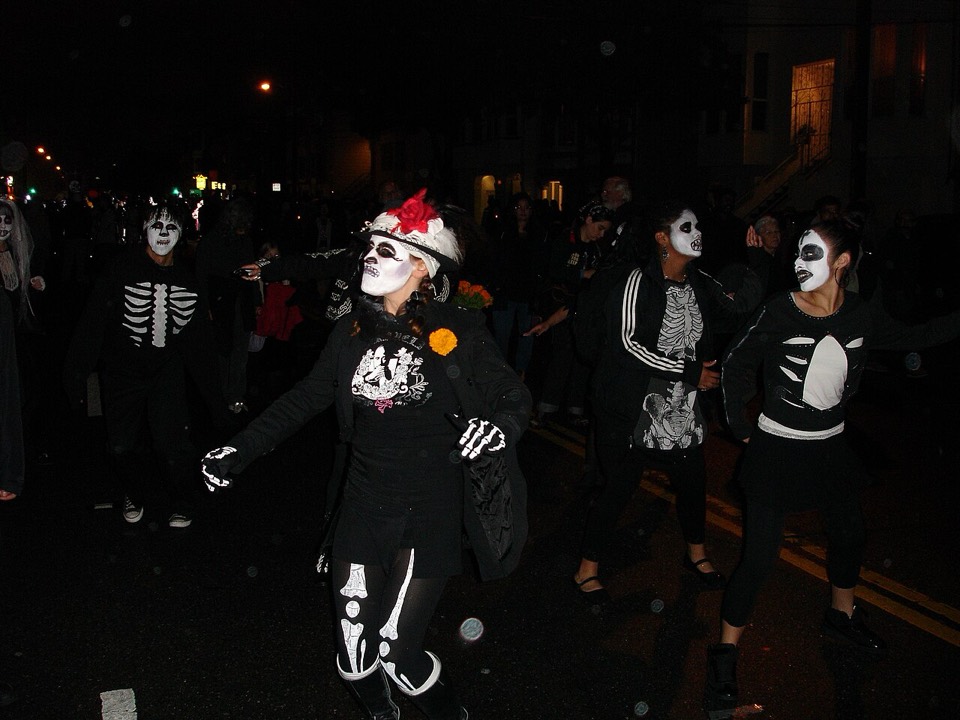
The photo: at night, a group of people in black skeleton costumes and white face paint walk together in a Day of the Dead procession in San Francisco.
Photo: Al83tito / Wikimedia Commons (CC0) (licence, source)

| Part | Notes | What you might say |
|---|---|---|
| What I see | Night, procession, skeleton costumes, white face paint | En primer plano se ve un grupo de personas vestidas de esqueleto, con la cara pintada de blanco. Es de noche y parece que caminan juntas en una procesión. |
| Cultural link | Día de Muertos, Mexico, remembering the dead | Esta imagen me recuerda el Día de Muertos, una tradición mexicana en la que las familias recuerdan a sus seres queridos fallecidos. Aunque la foto es de San Francisco, muestra que la tradición ha viajado con la comunidad mexicana. |
| What I don't see | Families, altars, the day before | No se ve a ninguna familia con ofrendas, así que me pregunto si es una celebración más pública que íntima. Si estuviera en México, probablemente habría altares con flores. |
Example in French
The photo: customers sit at tables under red awnings at a café terrace on a corner in Paris.
Photo: besopha / Wikimedia Commons, CC BY 2.0 (licence, source). Resized for the web.


| Part | Notes | What you might say |
|---|---|---|
| What I see | Terrace, red awnings, tables, tall buildings, a tree | Sur la photo, on voit des clients assis à des tables sous des auvents rouges, à la terrasse d'un café parisien. Il y a de grands immeubles et un arbre à côté. |
| Cultural link | Café terrace as social life in France | La terrasse est un lieu important de la vie sociale en France : on s'y retrouve, on discute, on regarde les gens passer. |
| What I don't see | Conversations, waiters, the weather | On ne voit pas ce que les gens se disent, mais j'imagine qu'ils parlent de leur journée. Si j'étais là, je prendrais un café et je regarderais les passants. |
Notice that the "what I don't see" sentences use tenses the description does not: me pregunto si, si estuviera... habría, j'imagine que, si j'étais... je prendrais. They are the ones that show range, and they come free once you ask what is missing.
Step by step: one practice
- Choose a photo. Use one from your class, or ten photo prompts with credit lines.
- Prepare against a timer. Use the same prep time your teacher says you will have in the exam, and fill in the three parts. Use key words, not full sentences. Check what notes the exam allows and practise with that limit.
- Speak and record. Present for the time you will have in the exam. Do not stop to correct yourself; keep going, as you would in front of an examiner.
- Answer three follow-ups. See below. Record these too.
- Listen back. Write down three things: a sentence you would say differently, a tense you did not use, and a place you stalled.
- Fix and redo. Say the three fixed sentences out loud, then do a short version again.
Practising the follow-up questions alone
This is the part most students skip, and it is where a lot of the oral is decided. You can ask yourself without preparing, if you pick the question at random.
After your presentation, pick one question from each kind:
| Kind | Spanish | French |
|---|---|---|
| Before | ¿Qué crees que pasó antes de esta foto? | Qu'est-ce qui s'est passé avant cette photo, à ton avis ? |
| After / future | ¿Cómo crees que será este lugar dentro de veinte años? | À ton avis, comment sera cet endroit dans vingt ans ? |
| If | Si pudieras estar en esta escena, ¿qué harías? | Si tu pouvais être dans cette scène, que ferais-tu ? |
| Opinion | ¿Te parece importante que se mantengan estas tradiciones? | Trouves-tu important que ces traditions soient préservées ? |
Answer each for at least thirty seconds. If you freeze, say a stalling phrase and keep going: Pues, depende..., A ver...; Alors..., Comment dire.... Then use the third column of your prep sheet: before, after, outside the frame.
If you have a friend, family member or classmate who can ask, ask them to choose a question you have not seen and to ask a second one that picks up something you just said. That is what the examiner does, and it is hard to fake alone.
A weekly routine
| Day | What | Time |
|---|---|---|
| Monday | One full practice with a new photo | About 15 minutes |
| Wednesday | Redo with the same photo, fix last time's three things | About 10 minutes |
| Friday | Five follow-up questions, no prep, recorded | About 10 minutes |
| Weekend | Pick one theme you have not practised and make a prep sheet for it | About 10 minutes |
Rotate through the five themes so that none is a surprise.
What to check in your recording
Ask three questions each time:
- Did I stay in the language? Count the English words.
- Did I use more than the present tense? Past, future, conditional, subjunctive: at least two.
- Did I give my own view? A description is not an opinion. Add "I think" and a reason.
Keep a note of the same mistake showing up week after week. That list is more useful than any grammar book.
Where Cadentia fits
If you want to speak out loud and get your own mistakes back, Cadentia is a speaking-practice tool for Spanish, French and other languages. You talk, get feedback on what you actually said, and see what to work on next. It is one way to practise alongside the routine above, and it does not replace your teacher's mock orals. You can sign up here.
More on the IB oral
- How to prepare for the IB Spanish B individual oral
- IB French B oral questions and preparation guide
- IB oral practice photos, with follow-up questions
- Teachers: IB Spanish B practice plan by theme
- Teachers: IB French B practice plan by theme
- How to describe a photo in Spanish and French for the IB oral
- What to do when your mind goes blank in a speaking exam
Frequently asked questions
How much should I practise before the oral?
Two or three full practices a week for the last month works for most students, with shorter drills in between. One honest practice with a recording and three fixes beats five where you just talk and hope.
What if I run out of things to say about the photo?
Move to the third column of your prep sheet: what you cannot see. What happened before, what will happen next, who is outside the frame, what the place is like on a normal day. There is almost always more there than in the photo itself.
Can I write my whole presentation out?
Check with your teacher what notes are allowed in the exam, and practise with that limit. Even where you can write more, a few key words work better than sentences, because you can look up from them and sound like you are talking.
I do not have anyone to ask me the questions. What can I do?
Use a list of question types and pick one at random after your talk: one about the past, one about the future, one that starts with 'if', one that asks for your opinion. Answer it out loud without preparing. You can also ask a friend to read the questions to you.