 Cadentia
IB Spanish ab initio Individual Oral: How It Works and How to Prepare
How the IB Spanish ab initio individual oral works: the photo, 15 minutes of prep, the three parts, what is marked, and how to prepare, with Spanish examples.
The ab initio oral can feel like a lot to ask of a beginner: a photo you have not seen, fifteen minutes to prepare, then several minutes of speaking Spanish with your teacher. But it is built for beginners, and it is the most predictable part of the course once you know its shape.
This guide explains how the IB Spanish ab initio individual oral works, what is marked, and how to prepare for it with simple Spanish that you can actually say under pressure. It is not official IB material, and your teacher's instructions come first.
How the oral works
This is how the IB Language ab initio guide (first assessment 2020) sets out the individual oral, as summarised by teachers and revision sites. The guide is the same for every ab initio language, so Spanish follows the same rules as French or Mandarin. Your teacher has the full guide, and the exact timings are theirs to confirm.
| Part | Roughly how long | What happens |
|---|---|---|
| Preparation | 15 minutes | You choose one of two photos, each linked to a different course theme. You can make brief notes. |
| 1. Presentation | 1 to 2 minutes | You describe the photo and link it to the theme and to the Spanish-speaking world. |
| 2. Questions on the photo | 3 to 4 minutes | Your teacher asks follow-up questions about the photo and what you said. |
| 3. General conversation | 3 to 4 minutes | Your teacher moves to at least one other theme from the course. |
In total the oral lasts about 7 to 10 minutes. It is your internal assessment, conducted and marked by your teacher, and it counts for 25% of your final grade according to the published course outline. A sample of orals is checked by the IB.
A note on dates. The IB has announced revised language courses for future exam sessions. If you are reading this a year or two from now, ask your teacher which guide your class follows.
The five themes
The ab initio course uses the same five themes as Spanish B: identities, experiences, human ingenuity, social organization and sharing the planet. The difference is that ab initio lists prescribed topics under each theme, and they are concrete and everyday:
| Theme | Prescribed topics |
|---|---|
| Identities | Personal attributes, personal relationships, eating and drinking, physical well-being |
| Experiences | Daily routine, leisure, holidays, festivals and celebrations |
| Human ingenuity | Transport, entertainment, media, technology |
| Social organization | Neighbourhood, education, the workplace, social issues |
| Sharing the planet | Climate, physical geography, the environment, global issues |
That list is your revision map. Every photo and every conversation question will touch one of those twenty topics.
What is marked
The oral is marked on four criteria. In our own words (the official descriptors are in the guide):
- Language. How much Spanish you can use and how accurately: vocabulary, simple structures, pronunciation clear enough to follow. This criterion carries the most marks.
- Message: the photo. Whether your presentation and answers about the photo are relevant and connect the photo to the Spanish-speaking world.
- Message: the conversation. Whether your answers in the general conversation are relevant and have some detail.
- Interaction. Whether you understand the questions and keep the conversation going.
The point to take away: the language criterion rewards Spanish that is clear and communicates, not Spanish that is impressive. A beginner who says Me gusta el carnaval porque hay música y baile clearly and confidently is doing what the oral asks.
The presentation: a 90-second shape
One to two minutes is short. Students who freeze usually freeze because they try to say everything. Use the same four moves every time:
- Where and who. En la foto hay... Es en... Veo a...
- What they are doing. Están bailando / comiendo / caminando...
- The link to the theme. Esta foto es sobre el tema de las experiencias, en particular las fiestas.
- The link to the Spanish-speaking world, and you. En México, el Día de Muertos es una fiesta muy importante. En mi familia, nosotros...
A worked example
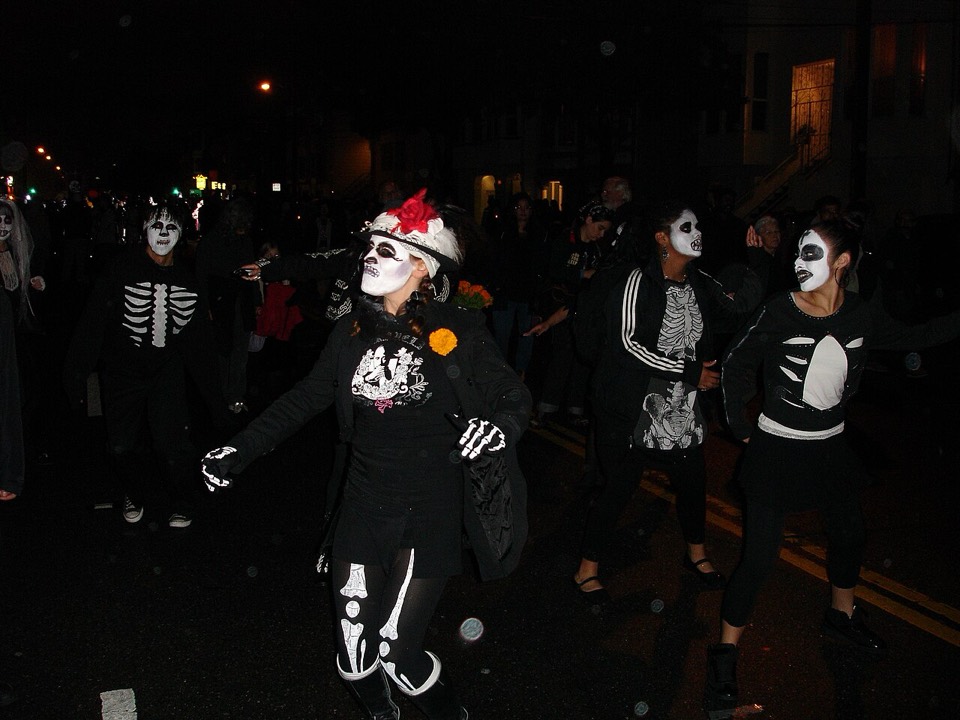
Photo: Al83tito / Wikimedia Commons (CC0) (licence, source)

Theme: experiences (festivals and celebrations).
Notes after 15 minutes might be no more than this:
- noche, calle, desfile, esqueletos, cara pintada, flores
- Día de Muertos, México, 1 y 2 de noviembre, recordar a la familia
- mi familia: Todos los Santos / el año pasado...
A presentation at ab initio level:
En esta foto hay un grupo de personas en la calle. Es de noche. Las personas llevan ropa negra con esqueletos blancos y tienen la cara pintada de blanco y negro. Una mujer lleva flores rojas en el sombrero. Creo que es un desfile del Día de Muertos.
Esta foto es sobre el tema de las experiencias, en particular las fiestas. El Día de Muertos es una fiesta muy importante en México. Se celebra el 1 y el 2 de noviembre. Las familias recuerdan a las personas que han muerto, con flores, comida y música. No es una fiesta triste. Es una fiesta alegre.
Me gusta mucho esta tradición porque es una forma bonita de recordar a la familia.
That is about a minute and a half at a calm speed. Count what is in it: hay, llevan, tienen, creo que, se celebra, me gusta... porque. No complex grammar, every sentence correct, and all four moves done. That is a strong ab initio presentation.
If you want one step up, add a past tense or a plan: El año pasado vi un desfile parecido en mi ciudad or Un día me gustaría ir a México para ver la fiesta. One sentence like that is enough. For a full phrase bank and a second worked example, see how to describe a photo in Spanish and French for the IB oral.
Part 2: questions on the photo
Your teacher will ask about what is in the photo, and then a little beyond it. Typical ab initio questions on this photo:
- ¿Qué llevan las personas de la foto?
- ¿Por qué crees que tienen la cara pintada?
- ¿Hay una fiesta similar en tu país?
- ¿Qué hiciste tú el año pasado para celebrar una fiesta importante?
- ¿Te gustaría celebrar el Día de Muertos? ¿Por qué?
Notice the pattern. The first is description, the second asks you to guess (creo que..., probablemente...), the third compares with your culture, the fourth wants a past tense and the fifth an opinion with a reason.
Answer in two or three sentences, not one. Use this pattern: answer, reason, a small detail.
P: ¿Te gustaría celebrar el Día de Muertos?
R: Sí, me gustaría mucho. Me parece una fiesta muy original y bonita. Además, me encanta la comida mexicana, sobre todo el pan de muerto.
Three sentences, all correct, with an opinion and a reason. That is exactly the level the oral is asking for.
Part 3: the general conversation
This is the longest part and the most predictable. Your teacher moves to at least one other theme, and the questions come from the prescribed topics. If your photo was about festivals, expect something like daily routine, school, food or your town.
Prepare a toolkit per topic, not a script. For each of the twenty topics, have:
- ten words you are sure of,
- three opinion sentences (me gusta, no me gusta, prefiero),
- one sentence in the past (el fin de semana pasado..., el verano pasado...),
- one sentence about the future (voy a..., me gustaría...).
Here is what that looks like for two topics.
Education
- Estudio en un colegio internacional. Mi asignatura favorita es la historia porque el profesor es muy simpático.
- No me gusta tener exámenes los lunes.
- El año pasado hice un intercambio con un colegio de Madrid.
- El año que viene voy a estudiar en la universidad.
Eating and drinking
- Normalmente desayuno cereales y un zumo de naranja.
- Prefiero la comida casera porque es más sana.
- Ayer cené pasta con mi familia.
- Este fin de semana voy a cocinar una tortilla de patatas.
Ten of these per topic and you will rarely be stuck for something to say. They will not come out word for word, and they should not. They are what you reach for while you think.
Common general conversation questions
- ¿Cómo es un día normal para ti?
- ¿Qué haces en tu tiempo libre?
- ¿Cómo es tu barrio? ¿Qué cambiarías?
- ¿Qué medio de transporte usas para ir al colegio?
- ¿Qué haces para estar en forma?
- ¿Cuáles son los problemas del medio ambiente en tu ciudad?
- ¿Usas mucho el móvil? ¿Para qué?
- ¿Qué te gustaría hacer en el futuro?
When you get stuck
You will hit a word you do not know. That is normal at ab initio, and it is not what loses marks. Silence does. Learn these few lines until they are automatic:
| Situation | Say |
|---|---|
| You need a second | Pues..., A ver..., Es una buena pregunta. |
| You did not understand | ¿Puede repetir, por favor?, ¿Puede hablar más despacio? |
| You do not know a word | No sé cómo se dice, pero es una cosa para... |
| You said one thing and stopped | También..., Además..., Por ejemplo... |
For a fuller guide to what to do when your mind goes blank, see what to do when your mind goes blank in a speaking exam.
A four-week plan
Three short sessions a week, about 15 minutes each. Always out loud, and record at least one session a week.
| Week | Focus |
|---|---|
| 1 | Identities and experiences: one photo each, the four-move presentation, then your toolkit for those eight topics |
| 2 | Human ingenuity and social organization: one photo each, toolkits for those eight topics |
| 3 | Sharing the planet, then mixed: answer five general conversation questions from random topics without notes |
| 4 | Two full mock orals with a timer: 15 minutes prep, then present, questions and conversation in one go |
After each recording, write down one sentence you would say differently and one word you were missing. Learn them before the next session.
Practising with Cadentia
Cadentia's IB oral practice follows the same steps as the real oral: pick a photo, prepare with a timer and notes, present out loud, then answer follow-up questions that are built from what you said, and a question on another theme. Afterwards you get feedback on your own sentences. It gives feedback, not a mark.
The IB Oral Prep Course is built for Spanish B and French B, so for an ab initio student it is a step up: useful if you want to stretch, but go at your own pace. If your teacher uses Cadentia with an ab initio class, they can set the IB oral task for the whole class at the right level, and it is free for you there. The first week of the course is free.
More on the IB oral
- IB Language B individual oral: the format, timing and marking explained
- How to describe a photo in Spanish and French for the IB oral
- How to prepare for the IB Spanish B individual oral
- IB oral practice photos, with follow-up questions
Cadentia is not affiliated with or endorsed by the International Baccalaureate. "IB" and "International Baccalaureate" are trademarks of the International Baccalaureate Organization. This guide uses our own wording and is not official IB material.
Frequently asked questions
How long is the IB Spanish ab initio individual oral?
Under the current guide (first assessment 2020), the oral lasts about 7 to 10 minutes after about 15 minutes of preparation. The presentation is about 1 to 2 minutes, questions on the photo about 3 to 4, and the general conversation about 3 to 4. Check the exact figures with your teacher, since the IB is revising its language courses.
Is the ab initio oral the same as the Spanish B oral?
The shape is similar: a photo, a presentation, questions on it, then a wider conversation on another theme. Ab initio is shorter, the presentation is shorter, and the language expected is simpler. Spanish B also has a Higher Level that works from a literary extract; ab initio is only offered at Standard Level.
Can I bring notes into the oral?
You can make brief notes during the preparation time and refer to them. You cannot bring prepared notes from home. Keep your notes to key words so you look up and talk instead of reading.
What if I do not understand the teacher's question?
Ask in Spanish: ¿Puede repetir, por favor? or ¿Puede hablar más despacio? Asking for clarification is part of interacting, and it is much better than guessing.