 Cadentia
How to Prepare for the IB Spanish B Individual Oral: A 15-Minute Plan
How to prepare for the IB Spanish B oral: the format in plain words, a 15-minute prep routine, a worked photo, phrases for when you freeze, and a 4-week plan.
You get a photo you have never seen, about fifteen minutes to prepare, and then you talk. Then the examiner asks questions you could not predict. That is the IB Spanish B individual oral, and it is the part of the course students say they feel least ready for.
The good news: it is very practisable. This guide gives you the format in plain words, a 15-minute prep routine you can repeat, a worked example on a real photo, what to say when you freeze, and a four-week plan.
It is written for Standard Level students. It is not official, and your teacher's instructions come first.
The format, in plain words
As we understand the Standard Level oral (check the current subject guide and your teacher for exact timings):
- Preparation, about 15 minutes. You see photos linked to the course themes and work with one. You can make brief notes.
- Presentation, a few minutes. You talk about the photo and connect it to the theme and to a Spanish-speaking culture.
- Questions on the photo. The examiner follows up on what you said.
- Wider conversation. The examiner moves to at least one other theme from the course.
At Higher Level the starting point is a passage from a literary work you studied, not a photo. Most of the advice below still helps, but the example is SL.
The five course themes are identities, experiences, human ingenuity, social organization and sharing the planet. Any of them can come up, so practise all five.
What examiners listen for
In our own words, not the official criteria, four things matter:
- Language. How much Spanish you can use (tenses, structures, vocabulary) and how accurately.
- What you say about the photo. A clear, developed description and interpretation, linked to a culture.
- What you say in the conversation. Ideas and opinions that go beyond the photo.
- How you interact. Answering the question that was asked, and keeping the exchange going.
For the official wording, ask your teacher for the subject guide.
The 15-minute prep routine
Most students use the whole prep time writing a description. Then they finish the description in ninety seconds and have nothing left. Divide your time instead.
| Minutes | What to do | What to write |
|---|---|---|
| 0 to 2 | Look. Choose your photo. Decide the theme. | The theme, in one word |
| 2 to 6 | Describe. Who, where, what, how it looks. | 5 or 6 key words, plus en primer plano / al fondo |
| 6 to 10 | Interpret and connect. Why it matters, what it says about a Spanish-speaking culture. | 2 ideas, 1 cultural fact you know |
| 10 to 13 | Outside the frame. Before, after, who is missing, your opinion. | 3 prompts: antes, después, si yo... |
| 13 to 15 | Read your notes. Choose your first sentence and your last. | Nothing new |
Key words, not sentences. If your notes are sentences, you will read them, and reading sounds like reading. Five words you can glance at let you look up and talk.
Plan the first sentence and the last. The first one gets you started without a pause. The last one ends cleanly instead of trailing off with y... ya está.
A worked example
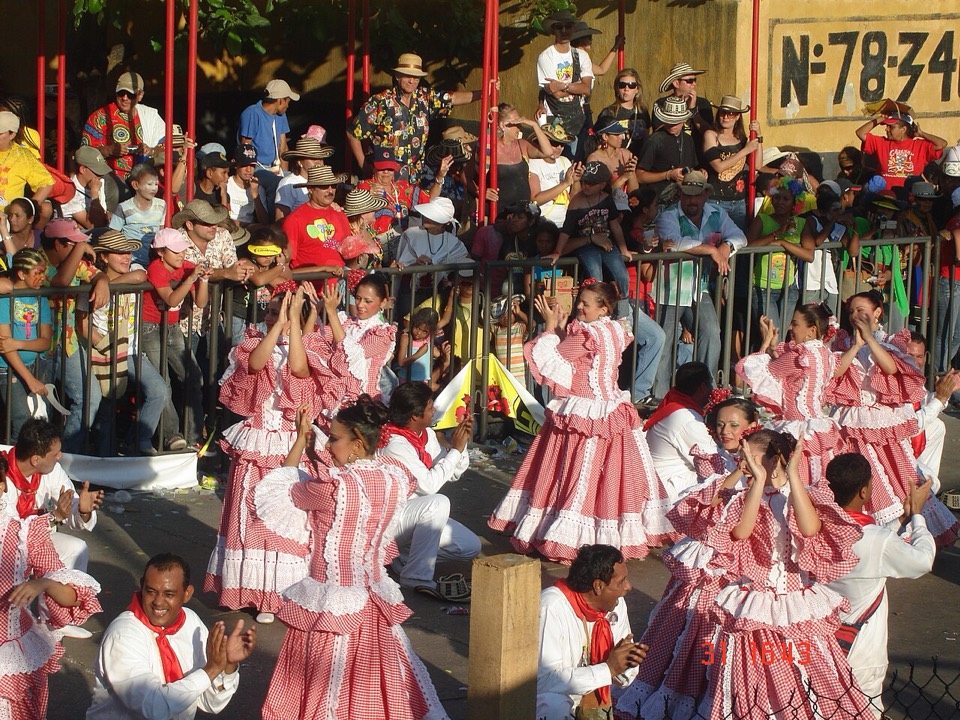
Photo: Norma Gòmez / Wikimedia Commons, CC BY 2.0 (licence, source). Resized for the web.

Theme: experiences (with a link to identities).
Notes after 15 minutes might look like this:
- carnaval, Barranquilla, cumbia, faldas, público, barrera
- fiesta = orgullo local; música del Caribe colombiano
- antes: ensayos, meses / después: cansancio, fotos / si yo...
Describe. En esta foto se ve a un grupo de bailarinas con faldas rosas y blancas. Están bailando cumbia en la calle, y al fondo hay mucha gente detrás de una barrera.
Interpret and connect. Creo que es el carnaval de Barranquilla, en Colombia. Para la gente de la costa, el carnaval es mucho más que una fiesta: es una forma de mostrar su identidad y su orgullo. La cumbia, además, es un baile tradicional de esa región.
Outside the frame. Lo que no vemos son los meses de ensayos. Seguramente las bailarinas practicaron muchísimo para que todo saliera bien. Si yo estuviera allí, me gustaría unirme al baile, aunque creo que no sabría seguir el ritmo.
Look at the grammar in the last paragraph: a past tense (practicaron), a subjunctive after para que (saliera), a si clause with the conditional (si estuviera... me gustaría), and aunque. None of it was forced. It came from asking what is outside the frame.
Follow-up questions you might get on this photo
- ¿Cómo crees que se prepararon estas bailarinas durante los meses anteriores al carnaval?
- ¿Es importante que los jóvenes participen en estas fiestas? ¿Por qué?
- Si pudieras bailar en el carnaval de Barranquilla, ¿cómo te prepararías?
Each one asks for a different structure: the past, the subjunctive after an opinion, and the conditional. That is typical. If you listen for the tense in the question, you know which tense to answer in.
Turn short answers into full ones
A follow-up answered in one sentence is a missed chance. Use a simple pattern: answer, reason, example, and a bit more.
Q: ¿Es importante que los jóvenes participen en estas fiestas?
A: Sí, creo que es muy importante que participen. (answer) Si los jóvenes no aprenden los bailes, la tradición puede desaparecer. (reason) Por ejemplo, en mi ciudad hay una fiesta que antes era enorme y ahora casi nadie la celebra. (example) Por eso me parece bien que los colegios organicen talleres de baile. (a bit more)
Four sentences, two subjunctives, a si clause and a past tense. That is the shape to aim for.
When you freeze
Everyone freezes at some point. What matters is that a missing word does not turn into a silence. Learn these and use them on purpose:
| Situation | Say |
|---|---|
| You need a second to think | A ver..., Pues, déjame pensar..., Es una buena pregunta. |
| You do not know a word | No sé cómo se dice, pero es una cosa que sirve para... |
| You did not understand | ¿Podría repetir la pregunta, por favor?, ¿Se refiere a...? |
| You want to change direction | Lo que quiero decir es que..., Dicho de otra manera... |
| You have said one thing and stalled | Además..., Por otro lado..., Y otra cosa... |
The second row is the most useful. Describing a word you do not know (una cosa que sirve para..., un lugar donde...) is fluent Spanish. Stopping is not.
When you stall on the photo itself, go back to the outside-the-frame prompts in your notes: before, after, who is missing, what you would do.
A four-week plan
Two sessions a week, about 20 minutes each, with a recording. Rotate the themes so none is a surprise.
| Week | Session 1 | Session 2 |
|---|---|---|
| 1 | Identities photo: full prep, present, record | Same photo: answer three follow-ups, fix three things |
| 2 | Experiences photo, full routine | Human ingenuity photo, full routine |
| 3 | Social organization photo, no notes while speaking | Sharing the planet photo, then a question on a different theme |
| 4 | A photo you have not seen, mock conditions, one go | Listen to week 1 and week 4 side by side. Fix your top three mistakes |
After each recording, write down three things: one sentence you would say differently, one tense you never used, one place you stalled. Next time, fix those first.
For photos to practise with, see IB oral practice photos with follow-up questions. For more on practising alone with a prep sheet, see how to practise the IB oral at home.
Practising the oral with Cadentia
Cadentia has an IB oral practice mode for Spanish B and French B, built around the steps above. You choose a theme, pick one of two photos, and prepare with a timer and notes. You present out loud, then answer follow-up questions that are built from what you actually said, and a question on another theme. At the end you get feedback on your sentences. There is a Practice mode, where your outline stays on screen and you can try again, and a Mock mode, which is one go with no notes while you speak.
It gives feedback, not a band or a mark. It is not a replacement for your teacher's mock orals.
You can use it two ways:
- On your own. The IB Oral Prep Course plans your weeks up to your oral: two practice orals a week on the IB themes, short general-discussion questions, your own mistakes back, and a weekly note for a parent if you want one. The first week is free. If your teacher already uses Cadentia, join your class with its code instead: it is free there.
- With your class. If your teacher uses Cadentia, they can set IB oral practice for the whole class. Teachers can read more at Cadentia for IB teachers.
More on the IB oral
- IB French B oral questions and preparation guide
- IB oral practice photos, with follow-up questions
- How to practise the IB oral at home
- Teachers: IB Spanish B practice plan by theme
- Teachers: IB French B practice plan by theme
- IB Language B individual oral: the format, timing and marking explained
- What to do when your mind goes blank in a speaking exam
Cadentia is not affiliated with or endorsed by the International Baccalaureate. "IB" and "International Baccalaureate" are trademarks of the International Baccalaureate Organization. This guide uses our own wording and is not official IB material.
Frequently asked questions
How long is the IB Spanish B individual oral?
As we understand the current Standard Level format, you prepare for about 15 minutes with a photo, present it for a few minutes, answer questions about it, then have a wider conversation on another theme. Higher Level works from a passage of a literary work instead of a photo. Timings and rules can change, so check the subject guide and your teacher for the exact figures.
Can I memorise my presentation?
You will not know the photo in advance, so a memorised speech will not fit. What you can memorise is a toolkit: openings, connectors, opinion phrases, a few subjunctive and conditional patterns, and rescue phrases. Those fit any photo.
What if I do not understand a question?
Ask for it to be repeated or rephrased, in Spanish. Asking for clarification is part of a real conversation. It is far better than guessing and answering a different question.
Does Cadentia give me a band or a mark?
No. Cadentia gives feedback on what you said: your sentences, corrected, and the patterns that keep coming back. Only the IB and your teacher mark the oral.