 Cadentia
IB French B Oral Questions by Theme, with a Preparation Guide
IB French B oral questions for all five themes, plus how to prepare: a prep routine, a worked photo, the structures to aim for and faux amis to avoid.
Many IB French B students have good vocabulary and a decent accent, and then lose marks in the oral by staying in the present tense. They describe the photo well. Then the follow-up questions arrive, and every answer starts with C'est... and Il y a....
This guide is about fixing that. It starts with example questions for each of the five themes, which you can practise with tonight, then covers a prep routine, a worked photo, the structures that show range and the faux amis to avoid.
It is written for Standard Level students. It is not official, and your teacher's instructions come first.
The format, briefly
As we understand the Standard Level oral (check the current subject guide and your teacher for exact timings): you prepare for about 15 minutes with a photo linked to one of the course themes, present it for a few minutes, answer questions on it, then talk about at least one other theme. At Higher Level the starting point is a passage from a literary work instead of a photo.
The five themes are identities, experiences, human ingenuity, social organization and sharing the planet.
In our own words, examiners listen for four things: the range and accuracy of your French, what you say about the photo (description, interpretation, cultural link), what you say in the conversation, and how you interact (answering what was asked and keeping it going). Ask your teacher for the official criteria.
Example questions by theme
Practise these out loud, without preparing. Answer each for at least thirty seconds: answer, reason, example, and one more thing.
Identities
- Qu'est-ce qui a le plus influencé ton identité jusqu'ici ?
- Penses-tu qu'on puisse avoir deux cultures à la fois ?
- Si tu devais vivre dans un autre pays, qu'est-ce qui te manquerait le plus ?
Experiences
- Raconte un voyage ou une fête qui t'a marqué.
- Est-il important que les jeunes voyagent avant de commencer à travailler ? Pourquoi ?
- Si tu pouvais assister à un festival n'importe où dans le monde, lequel choisirais-tu ?
Human ingenuity
- Comment la technologie a-t-elle changé la façon dont tu communiques avec ta famille ?
- Faut-il que l'école apprenne aux élèves à utiliser l'intelligence artificielle ?
- Si tu pouvais inventer quelque chose, qu'est-ce que ce serait ?
Social organization
- Comment ton quartier a-t-il changé ces dernières années ?
- Est-il juste que certains travailleurs aient moins de droits que d'autres ?
- Si tu étais maire de ta ville, quelle serait ta première décision ?
Sharing the planet
- Qu'est-ce que tu as déjà fait pour réduire ton impact sur l'environnement ?
- Penses-tu que les gestes individuels suffisent pour protéger la planète ?
- Si on interdisait les voitures dans le centre de ta ville, qu'est-ce qui changerait ?
Each set goes past, opinion, hypothetical, which is roughly how follow-ups climb in difficulty. For more, with a photo per theme, see IB oral practice photos with follow-up questions.
A prep routine that leaves you something to say
Divide the 15 minutes into blocks, and write key words, not sentences.
- Describe (about 4 minutes). Who, where, what. Use au premier plan, à l'arrière-plan, à gauche, à droite.
- Interpret and link (about 4 minutes). What does this say about life in a French-speaking place? One fact you know.
- Outside the frame (about 4 minutes). What happened before, what will happen next, who is missing, what you think.
- First and last sentence (the rest). Plan how you start and how you end.
Block 3 is the one most students skip, and it is where the past, the conditional and the subjunctive come from.
A worked example
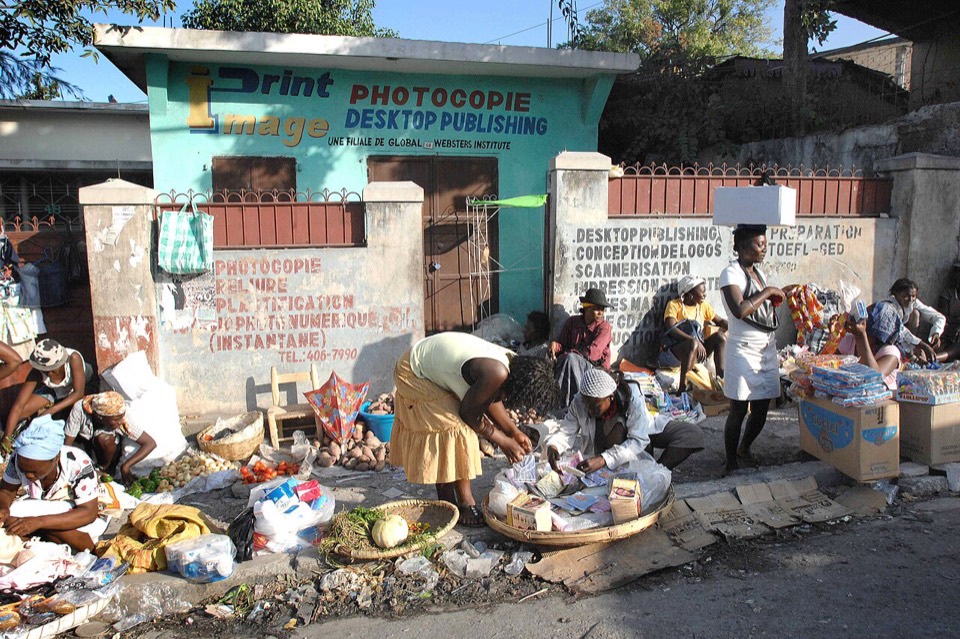
Photo: Fred W. Baker III / U.S. Department of Defense (public domain), via Wikimedia Commons (source). Resized for the web.

Theme: social organization. Place: Port-au-Prince, Haiti.
Notes: trottoir, femmes, fruits, paniers, boutique de photocopies / économie informelle, Haïti, francophone / avant : séisme 2010 ? / si j'avais un commerce...
Describe. Au premier plan, on voit des femmes accroupies sur un trottoir. Elles installent des fruits et d'autres produits sur des paniers et des tissus. À l'arrière-plan, il y a une petite boutique de photocopies avec des panneaux peints à la main.
Interpret and link. Je pense que la photo a été prise en Haïti, un pays des Caraïbes où l'on parle français et créole. Elle montre l'importance du commerce de rue : pour beaucoup de familles, c'est la principale source de revenus.
Outside the frame. La photo date peut-être de 2010, quelques jours après le tremblement de terre qui a détruit une grande partie de la ville. Ce que je ne vois pas, ce sont les marchés couverts, dont beaucoup ont peut-être été endommagés. Bien que la situation soit difficile, ces femmes continuent à travailler. Si j'étais à leur place, je ne sais pas si j'aurais autant de courage.
In that last paragraph: a passive (a été prise), a past tense (a détruit), dont, a subjunctive after bien que (soit), and si + imparfait with the conditional (si j'étais... j'aurais). That is range, and it came from the "outside the frame" notes.
One caution: only state facts you are sure of. If you do not know when a photo was taken, say j'imagine que or peut-être, not a date.
The structures to aim for
You do not need all of these in one oral. Two or three, used well, do more than five forced in.
| Structure | Pattern | Example |
|---|---|---|
| Past contrast | passé composé for events, imparfait for background | Quand je suis arrivé, il pleuvait. |
| Subjunctive | il faut que, bien que, je ne pense pas que | Il faut que les jeunes s'engagent. |
| Si clauses | si + imparfait, then conditionnel | Si j'avais le choix, j'habiterais à la campagne. |
| Relative pronouns | qui, que, où, dont | C'est un problème dont on parle beaucoup. |
| Passive | être + participe passé | Ce festival a été créé dans les années 90. |
| Connectors | cependant, en revanche, d'ailleurs, c'est pourquoi | C'est pratique ; en revanche, c'est cher. |
Listen to the question. It tells you which structure to use. Qu'est-ce qui s'est passé...? wants the past. Si tu pouvais...? wants the conditional. Est-il important que...? is a chance to use the subjunctive in your answer.
Faux amis to watch
These sound like English and mean something else. Examiners notice them.
| French | Means | Not |
|---|---|---|
| actuellement | currently | actually (en fait) |
| éventuellement | possibly | eventually (finalement) |
| sensible | sensitive | sensible (raisonnable) |
| assister à | to attend | to assist (aider) |
| une librairie | a bookshop | a library (une bibliothèque) |
| rester | to stay | to rest (se reposer) |
| passer un examen | to take an exam | to pass one (réussir un examen) |
When you are stuck
| Situation | Say |
|---|---|
| Thinking time | Alors..., Voyons..., C'est une bonne question. |
| Missing word | Je ne connais pas le mot exact, mais c'est une chose qui sert à... |
| Did not understand | Pourriez-vous répéter la question, s'il vous plaît ? |
| Reformulate | Ce que je veux dire, c'est que..., Autrement dit... |
Describing a word you do not know is fluent French. A silence is not.
A four-week routine
| Week | What to do |
|---|---|
| 1 | Two photos, full routine, recorded. Note the tenses you used |
| 2 | Two more themes. Add one si clause and one subjunctive on purpose |
| 3 | Last theme, then the question bank above with no prep |
| 4 | A photo you have not seen, mock conditions, one go. Compare with week 1 |
After each recording, write down one sentence to fix, one structure you did not use, and one faux ami or anglicism you caught. For a prep sheet you can reuse, see how to practise the IB oral at home. Teachers: there is a five-week IB French B plan by theme.
Practising with Cadentia
Cadentia has an IB oral practice mode for French B and Spanish B. You choose a theme, pick one of two photos, and prepare with a timer and notes. Then you present out loud and answer follow-up questions built from what you actually said, plus a question on another theme. At the end you get feedback on your sentences. Practice mode keeps your outline on screen and lets you try again; Mock mode is one go with no notes while you speak.
It gives feedback, not a band or a mark, and it does not replace your teacher's mock orals.
- On your own: the IB Oral Prep Course plans your weeks up to your oral: two practice orals a week on the IB themes, short general-discussion questions and your own mistakes back. The first week is free. If your teacher already uses Cadentia, join your class with its code instead: it is free there.
- With your class: your teacher can set IB oral practice for the whole class. Teachers, see Cadentia for IB teachers.
More on the IB oral
- How to prepare for the IB Spanish B individual oral
- IB oral practice photos, with follow-up questions
- How to practise the IB oral at home
- Teachers: IB Spanish B practice plan by theme
- Teachers: IB French B practice plan by theme
- How to describe a photo in Spanish and French for the IB oral
- IB Language B individual oral: the format, timing and marking explained
Cadentia is not affiliated with or endorsed by the International Baccalaureate. "IB" and "International Baccalaureate" are trademarks of the International Baccalaureate Organization. This guide uses our own wording and is not official IB material.
Frequently asked questions
How is the IB French B oral structured?
As we understand the current Standard Level format, you prepare for about 15 minutes with a photo, present it for a few minutes, answer questions about it, then have a wider conversation on another theme. Higher Level starts from a passage of a literary work instead. Check the subject guide and your teacher for exact timings.
Should I use tu or vous with the examiner?
Use vous unless your examiner clearly invites you to use tu. Examiners are often your own teachers, and many will use tu with you, but vous is never wrong.
Which French-speaking cultures can I talk about?
Any of them. France is the obvious one, but Quebec, Belgium, Switzerland, Senegal, Morocco, Haiti and many others are all French-speaking. A link outside France often gives you more to say and stands out.
Does Cadentia mark my oral?
No. Cadentia gives feedback on what you said, with your own sentences corrected. It does not give a band or a mark. Only the IB and your teacher do that.